Showing posts with label creativity. Show all posts

Sunday, June 20, 2021

I'm glad my dad taught me to draw...

 My dad, Tom Emig, with my sister Cheri, and me, about 1972.

For this Father's Day, I figured I'll blog about my dad, because he's the guy who taught me how to draw.  As a little kid growing up in small town Ohio, a career in art, or making a living at any kind of creative work, was out of the question.  Art was for "those weirdos" in New York City and L.A..  The kids I grew up expected to either work in a factory, on the assembly line, or in the office next to the factory.  My dad, Tom Emig was a draftsman, he drew huge pictures of machines, and machine parts, which the guys in the shop used to build the items.  Drafting was as "artsy" as you could get away with, back then, in the Midwest.  As I grew up, dad worked his way up to being an engineer, despite not having a college degree.  He was a mechanical genius, he deeply understood  how machines worked.  I did not inherit that.  But I did love to draw.

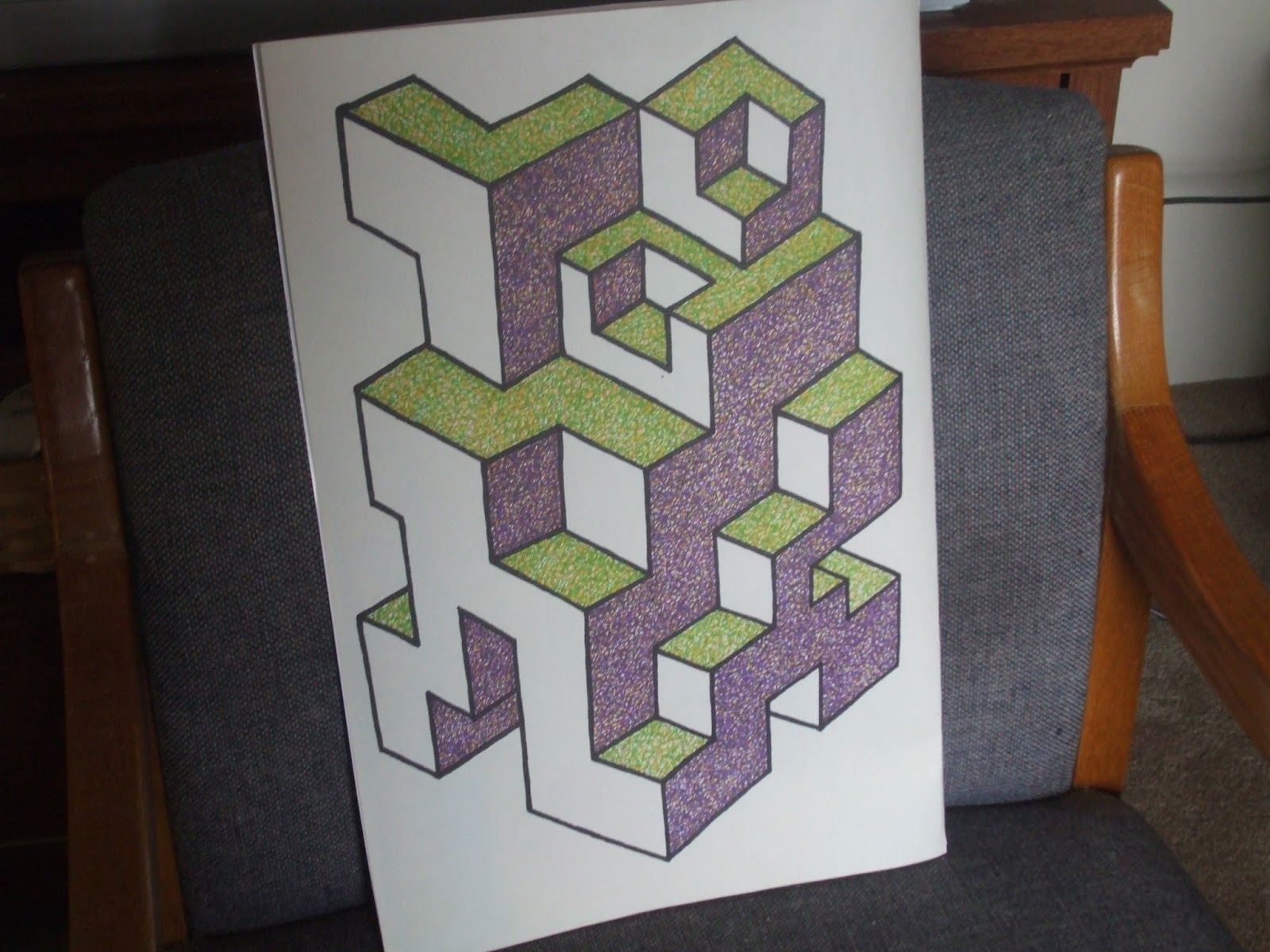
One of my Sharpie scribble style drawings from about 2011, using the isometric drawing ideas my dad taught me when I was about 11.

 One day, on a camping trip, when I was 8, I was sitting outside our little camper drawing something, probably a curvy car, like all us kids drew.  My dad sat down next to me, and asked, "Want to see how to draw a Jeep?"  By Jeep in those days, he meant the classic "Army Jeep," originally made by Willys.  Movies and TV shows about world War II were big in the 1970's, along with the TV show MASH, which all featured Willys Jeeps, so they were a cool thing to us 70's kids to draw.  My dad showed me how to draw a side view of a Jeep in about 2 minutes.  He drew one, which I'd never seen him draw before.  Then he got a piece of paper, and I had one, and he showed me, step by step, how he did it.  One tire, then the other, then draw the body around the tires.  In ten minutes, I was drawing really cool Jeeps.

Seriously, it was freakin' amazing.  I was in 3rd grade, and Jeeps, tanks, and halftracks, were our favorite things to draw in school, when we were supposed to be doing classwork.   There were about 5 or 6 of us boys who were good at drawing, always competing to outdo each other.  My dad's simple way to draw a Jeep blew my mind, and I practiced it the whole weekend on the camping trip.  I probably drew 10 or 20 Jeeps that weekend.  

A long way from those early Jeep drawings, here's a convertible VW bug I drew in 2019.  #sharpiescribblestyle

 But the best part came when I went back to school that Monday morning.  From being about the #5 drawing kid in class, I sat down and drew a Jeep before class, and blew the other kids' minds.  My new Jeep drawing skill catapulted me into the #2 spot, of the kids in class.  One kid could draw really good tanks, so he retained his title as #1, in the other kids opinion, but I was a solid #2 suddenly.  That totally helped my confidence in art, and I quickly used the Jeep drawing skill, and started turning out solid halftrack and tank drawings, vying for the #1 spot in class.  While shy and dorky in most cases, I became "the kid who draws Jeeps really good," which was a cool status back then.  

Looking back, my dad sitting down for a few minutes, and teaching me to draw a good Jeep, also helped me find something I was good at.  I was a smart, dorky, super shy kid, who sucked at sports (except dodgeball), and I caught a lot of crap from other kids.  But drawing was something that commanded some respect in school, and becoming "officially" good at something many other kids respected, helped me cope.  And it got me drawing even more.  Drawing pictures became a go-to for me when overwhelmed by all the other B.S. in life.  It also helped me keep in touch with my creative side as most other kids were losing their creativity to "growing up."  

Kurt Cobain drawing from 2017, used as a flyer for my first solo art show in Winston-Salem, NC. #sharpiesctribblestyle

 Two or three years later, my dad taught me basic drafting skills, how to draw the top, side, and front view of an object, using the 45 degree line in the corner to transfer lines and points.  He also taught me to draw isometric and oblique angles, another basic drafting skill.  This led to getting straight A's in drafting in high school,  and also led to me being a "creative dude," in general, which led to getting into pottery in high school, something else I got good at.  

More than anything, getting "good" at drawing as a young kid, encouraged me to spend a lot of time doing creative things.  I was a huge daydreamer, and always had big dreams, but never really tried to make them happen.  But I could sit down and draw for 45 minutes, no problem.  This kept me in touch with, and experimenting with my creativity as I grew up.  That later led to publishing a zine, which was the first longer term creative project that I really committed to.  That zine led to a BMX magazine job at age 20, and that changed the entire course of my life. 

"Harley Quinn/Joker Tainted Love" drawing, 2018.  This is my personal favorite Sharpie drawing that I've done.  I had to sell it cheap while in Richmond, Virginia.  I got out of the hospital after a week long stay from an allergic reaction to medicine, and I needed money to get a motel room for a night.  Still bummed I lost this one.  #sharpiescribblestyle

 From there, I wrote for magazines, edited and shot photos for a newsletter.  Then I got the chance to produce videos, and that got me into video and TV production.  My point here is that helping a kid learn to draw for ten minutes, or do some other creative activity that they're interested in, helps not only their self-esteem at the time, but helps them learn to work with their creativity in general.  And that has lifelong, lasting effects.  While I don't make a decent living (at the moment), I'm now one of those "artsy weirdos in L.A.."  I'm now best known as a Sharpie artist and blogger.  And in today's world, creativity has huge value, and much of our culture and economy is based on creative activities.  So teach your kids to draw, or paint, or sculpt, or play music, or whatever, when they're kids.  In this post, you can see that I've evolved from drawing Army Jeeps.  

Sumatran tiger drawing, 2018.  #sharpiescribblestyle
Michael Jackson drawing, 2018. #sharpiescribblestyle
David Bowie with Bowie knife, 2019.  #sharpiescribblestyle
"Peek-a-boo."  I'd been wanting to draw eyes real big for a while, so I tried it in 2020.  #sharpiescribblestyle


Friday, April 16, 2021

Planting flowers in Hell: poetry, other arts, and the gift and dedication of creativity

My favorite bands are mostly punk bands, the music I listen to most often, are bands like Social Distortion, The Descendents, and Face to Face, and several others.  But when I'm in a creative mood, actually working on creative projects, I listen to this entire concert of the Lilith Fair in 1997.  I've watched and listened to this dozens and dozens of times.  This is one of the best documentaries on creativity I know.  

"Writing's so bizarre.  I think that's why it's so fulfilling.  It's like you're... you're making something out of nothing."

-Shawn Colvin, Lillith Fair, 1997 documentary (above)

To be able to reach into the void, to literally stretch your soul out into that other dimension, and bring out something new, something you think the world needs, to breathe life into it, and set that creative piece on its journey into the physical world, that is the work of an artist.  And that work requires every bit as much dedication as that of a doctor, or a soldier, to do it well, and do it consistently.  An artist, a poet of life, may not fight battles with guns, but we are always fighting battles. 

While in North Carolina, three years ago, living in a tent in the woods, and drawing my Sharpie art day after day, fighting the darkness of the deep shadows of the worst aspects of Old Southern Culture, it seemed like I was planting flowers in Hell.  I wondered if it was all worthwhile many times, like when I was hunkered down, under a tarp, inside my tent, as a Carolina thunderstorm raged around me, thinking about drawing at the library the next day.  One day I realized, if you plant enough flowers in Hell, it doesn't feel like Hell anymore.  That is our work as artists. 

To keep trying, keep creating, to build our technical skills, and learn our own creative process, to bring new things, new creative works, new ideas, into the world.  That is our job.  If you dedicate yourself to that over the long term, you eventually build up the drive to keep going no matter what forces of the evil parts of the everyday human world throw at you, or our own fears and personal demons we may be wrestling with. 

 That is our job.  We light matches in the darkness and create new lights to share and pass around and light new paths.  To do that, we must be sensitive to the creative sparks and the nuances, but also build a toughness to break past the doubters and haters.  At this point, if you put me in front of a firing squad, condemned to die a moment later by the executioners' guns, I'd write a haiku on the spot and recite it, as my last work in this world.  

You pull the trigger

Sending lead death to end me

A poem comes, I win

Sometimes it takes that level of dogged dedication to be an artist.  History would forget the names of the firing squad members, and the leader who told them to shoot.  But that poem, that haiku would be written down and remembered, I guarantee it.  

Yes, sometimes it takes that level of dedication to your creative work to be an artist.  Most of the time it does not, thankfully.  But there is a dedication to being a poet, a painter, a sculptor, a songwriter, a musician, a dancer, a content creator, a director, a producer, an inventor, a graphic designer, whatever.  You may not face the firing squad for your creative work, but you face days of creating crap, you face your insecurities, your personal bad habits, your doubts, your mom's doubts, your dad's doubts, everybody's doubts.  You face moments, even days, where it doesn't seem to be working.  

And then... that spark comes, from somewhere.  That next right idea that you need to create.  But the spark is the just that, the spark, it is not the poem, the song, the play, the finished work.  Then comes the dedication that you've built over time, the work to take that creative spark and form it with your technical skills, into the piece of art to share with others.  

Some pieces of art may be instant hits, going viral in your genre' to be admired and to inspire many people in a short amount of time.  Other pieces may not receive much initial excitement at all.  They may sit out there in the world, seemingly unnoticed, for months or years.  But in that time, in their place, those pieces inspire one person here, and another there.  And years later someone thanks you for creating that piece or work you'd long forgotten about.  It did have a purpose, it was needed in the world at the time you created it.  Maybe that "failure" ultimately inspired entire new people and new ideas while you went on, busy elsewhere.  You never know.  

There is a reason we are driven to create something.  Sometimes it's just for our own survival.  Sometimes we just need to get out of our everyday mindset and goof around, and make something to keep our own spirits up.  Sometimes we create a gift for someone dear to us, to help them through a dark time.  Sometimes we create a piece of art that speaks to many, many people.  Sometimes we may create something that seems like no big deal at the time, but it sparks a whole new genre' of creativity in other people.  Sometimes we may create a work that speaks to our times, and helps drive a major, needed,  a change in society itself.  

We never know, as artists what effect a certain piece will have.  Our job is to actually live life, and to learn and grow as artists, to dedicate ourselves to doing the best work we can, as we journey through life.  Our job is to learn our own creative process, to follow our our weird path, to build our technical skills, and to drop everything and create that next piece of work when the spark hits us.  

The world of humans needs our work, even if it may not seem like it at the time.  The world needs us, as artists, no many how many mean and seemingly evil people (most of whom are blocked artists themselves) may try to destroy us.  The world needs new creative pieces of work, new ideas, of all kinds, constantly.  The world needs you to create.  Do your best to hold up your end of the bargain.  Keep creating.

Become

You must risk

If you're to succeed

From when we grow

Sometimes we bleed

Each must climb

Over the fence

For the only cage

Is ignorance

Each Jedi Knight

And Shaolin monk

Evolved from

A lowly punk

Don't get caught

In the world's throws

We must become

Our own heroes


-The White Bear 

(aka me, Steve Emig)

A couple of memes I made a while back, on the idea of creativity...


Sunday, February 28, 2021

The Importance of Creative Scenes

Me getting creative on my freestyle bike, underneath the Huntington Beach Pier, 1987.  Apparently I was too broke to get a haircut at the time. 


We've all heard of cities that have a good music scene or a great art scene.  But what does that mean really?  What is a scene?  While a lot people like to go see a live band in a bar or club, or check out a gallery of local artists, do these things really matter much?  Aren't art and music scenes just place where artists, musicians, hippies, weirdos, and other people who don't want to really work hang out?  As a kid growing up in the 1970's and 1980's, that was what I heard about art and music scenes.  

My own interest in what I now call "creative scenes" began in October of 1982.  I was in my junior year in high school in Boise, Idaho, and my family lived in a trailer park outside of town, that we called Blue Valley.  We weren't diehard trailer trash, my parents moved there to save money for a year or two, so they could buy a house in town.  Unlike most of their financial plans, that plan ultimately worked.  

But, over the summer of 1982 in Blue Valley, us teenage guys in the park got more and more into BMX riding, since there wasn't much else to do.  That fall, someone heard there was actually a BMX track in Boise.  Four of us packed into a Ford Pinto, with 3 bikes, to go check it out.  Scott, Rocky, and Brian all won trophies in their first races, while I watched and coached.  We were hooked.  The next weekend, we packed the whole posse, 9 or 10 of us, with all our bikes, into my dad's Ford van, and headed to the Fort Boise BMX track.  It was the last race of the season.  That day, something weird happened.  Us trailer park kids, with cheap, crappy, bargain store bikes, in blue jeans and T-shirts, with paper plate number plates, all raced really well, for our first or second races.  Every one of us went home with a trophy, most for 1st or 2nd place in our class.  The Boise track locals, on $400-$500, high end BMX racing bikes, in their fancy racing leathers, couldn't figure out who we were, where we all came from, or why we were all so damn fast, for newbies.  

For us in Blue Valley, over several months, BMX was our thing.  We had been going out to our little jumps on the edge of the desert, and trying to out ride each other, day after day after day.  I later realized, we had developed a BMX bike scene.  We were a small group of people, with one dominating common interest, who got together, (daily, in our case) to push each other to get better.  That's what I now call a "creative scene."  We weren't making art or music, but we were learning jumping tricks on our bikes, and trying to invent a trick or two.  Not super creative, but somewhat creative.  We raced each other, practiced carving through turns, and speed rolling jumps.  But mostly we tried to jump for style better than all the other guys. At that time BMX racing was a sport, only 12 years old, and BMX trick riding, an offshoot, was just morphing into a sport of its own, called BMX freestyle.  

As I got more into freestyle in 1983 and 1984, a sport born in Southern California, I began to hear of small groups of freestylers around the country, and later in Canada and the U.K.  The BMX magazines sometimes covered these little scenes, or sometimes kids got letters published in the magazines, about their local group of riders. BMX freestyle was about doing learning tricks on BMX bikes, and inventing our own tricks, and it was highly creative, as well as a physical "sport."  

As BMX freestyle grew, it seemed to pop up in small groups, in different places around the country.  Freestyle didn't grow evenly across the U.S., town by town, city by city.  After the original riders, like Bob Haro, Bob Morales, R.L. Osborn and Mike Buff, in the South Bay area near Los Angeles, groups of freestylers popped up in San Francisco, San Diego, Kansas City, Austin, New York City, and obscure places likeYork, Pennsylvania, Elgin, Illinois, small towns in New England, and the three of us in Boise, as well as couple dozen other places.  

One or two riders would see a factory team trick show, get hooked on the idea of BMX freestyle, and get a couple other people into it, and start their own trick team.  That trick team would do shows and spread the word of this weird little sport in their area, drawing more riders in.  I didn't realize it then, but along with trying to eventually become a pro BMX freestyler, by riding daily, I was also witnessing how a creative scene grows from a couple dozen people, to a worldwide sport and industry.  BMX freestyle was also a part of the larger action sports movement, spawned mostly by surfing and motocross, and including skateboarding, snowboarding, rock climbing, mountain biking, wake boarding, and other new sports.  Our weird little sport, credited to one person, Bob Haro, is now worldwide, on TV, the internet, and social media, part of the X-Games, and will demo in the next summer Olympics.  None of that was planned in the early 1980's, it just happened organically.  It started with high school age kids having fun on bikes. 

That's what "creative scenes" do, at times.  They start with one or two people, with some new idea involving some form or creativity.  It can be a new style of art.  The Impressionists, were a scene in their day, taking painting in a new direction.  It can be music.  It can be entrepreneurial, spawning a new business, or even a new industry.  It can be technology.  Steve Wozniak and Steve Jobs, creating the first Apple Computer to share with the local Homebrew Club, in San Jose, in the 1970's, that was both a technological scene (computer enthusiasts), and soon after, an entrepreneurial scene, Apple Computers (now simply Apple).  These scenes just kind of happen, and it's hard to engineer one to grow into a worldwide movement or industry.  Research centers in major companies and universities are attempts to create creative scenes, usually around technology of some sort, but with major business potential.  These centers of innovation come up with a lot of ideas, but most don't take off and go very far. Some do, and spawn new products, businesses, and industries.

The best scenes, judged by overall influence on society, just seem to happen, and they seldom happen where major corporations want them to.  Jobs and Wozniak borrowed ideas from corporations that were trying to create major technological breakthroughs, and then created the personal computer revolution in a garage, a few miles from highly funded research centers.  

Creative scenes don't have to spawn major businesses to be highly successful, influential, and beneficial to society.  The Beat Poets didn't become billionaires, but their initial small poetry scenes influenced a huge part of their generation, as did the Acid Rock bands and Hippie culture of San Francisco's Haight/ Ashbury District in the late 1960's.  Whether that was mostly a good influence or a bad influence,depends on who you ask.  A lot of great art, music, and things like meditation became popular as a result.  But then, hallucinogenic drugs became popular, also.  

Some creative scenes just give local creative types a place to try ideas, experiment, and become more creative people in general. Those scenes are incredibly important in the overall scheme of things.  Those are the "nursery" scenes where a lot of people, often afraid to try new ideas, find out, "Hey, I can make something interesting."  The kids who have good creative scenes, some organized, others totally unorganized, gain some confidence, and begin to get better at bring creative in general.  Often great creative people had little known scenes they were a part of early in life, that sowed the seed of using creativity on a regular basis.  Those seeds often blossom years later, in art, music, or other creative endeavors.   

Other creative scenes take root in a part of a city or town, and then attract more creative people, of various kinds.  Some creative scenes become legendary places in their genre's.  Think of Hollywood (a mile form me, as I write this), a major creative scene for movies, TV, and music.  Broadway in New York City is a legendary creative scene for live theater.  New Orleans is a famous creative scene for its culinary and music roots.  Nashville is the major creative scene for country music, and now all kinds of music.  Austin, Texas became a creative scene for music, followed later by art, movies, and high technology. When it comes to the business end of things, the world's most famous creative scene (and creator of billionaires) is the San Jose, California area, aka Silicon Valley, for computer related high technology.  

In the 1990's, as computer technology, and other tech began to take off exponentially, it became apparent that these new high tech businesses clustered in a few areas.  Silicon Valley/San Francisco Bay Area, Boston, Seattle, Los Angeles, Austin were the standouts.  The Raleigh Research Triangle (Raleigh/Durham/Cary) in North Carolina was the first major high tech campus area.  But Silicon Valley, and the others listed, sprang up faster and larger.  Dozens of other cities were trying to create and build high tech centers, but the best start-ups kept gravitating to these, and a few other cities.  

Professor Richard Florida, then at Carnegie Mellon University in Pittsburgh, dove into the research on this phenomenon, trying to figure out why high tech firms clustered in certain areas.  After all, the rise of the internet, and personal computers, meant people could work from most anywhere.  After several years, he wrote The Rise of the Creative Class, in 2002, sharing his initial  findings (here's a speech from then).  While there were many reasons for this clustering, the underlying theme was that tech people were highly creative people, and creative people liked to be around other creative people.  The high tech workers creating the new technology liked to set up in cities that had good art and music scenes, and other groups of highly creative people, already living there.  They also liked to live in places that were tolerant of weird and unusual people.  Computer nerds really were mostly serious nerds then, and they'd been picked on enough.  So they migrated to places tolerant of all kinds of people.  That explains Austin, Texas as a tech hub, their city motto is "Keep Austin Weird."  

So while creative scenes can happen anywhere, and most live as small local scenes, some scenes spark a new idea that takes off in art, music, technology, or some other area.  Places with solid creative scenes in one area, often attract more creative people from other facets of the creative spectrum.  And these areas attracted tech workers, and still do.  So our most innovative cities and areas, that are now a huge part of the U.S. economy, and centers for most of our innovation, often started with tiny art or music scenes, decades ago.  Over years, they attracted other creative people, and became "scenes of creative scenes," inter-meshed with each other.  Some of these cities eventually became the tech hubs where most of the United States economy is now centered.  There are both good and bad aspects to this arc of creative scenes into known "creative cities", and into tech hubs.  Ask the old time locals in San Francisco, Seattle, or Austin about real estate prices, the Yuppie invasions, and often homelessness issues, as well. 

My point here is that a group of weird, screwball, seeming degenerates can be the seed of a great place for innovation in many different areas, and that can ultimately grow into major business ventures at times.  It's for this reason, and my fascination with Creative Scenes since that BMX race in October of 1982, that I'm focusing most of my time and energy on this concept in the coming months, and maybe years. 

We have a ton of major issues to work out in society right now, and creativity itself, new ideas and new solutions, are needed.  A handful of people, who just start doing creative things on a regular basis, usually come up with these new ideas that ultimately transform society in a meaningful way first in neighborhoods, then towns and cities, and then across regions and nations.  Those little creative scenes, the ones that will transform our lives in the next 10-20-30 years, could be happening ANYWHERE right now.  

While forcing creative scenes rarely seems to have good results.  Creative  scenes CAN be nutured as they grow.  Our country needs that right now.  Pretty much everywhere.  I'll have lots more insights and ideas on art, writing, creativity, and creative scenes, in coming blog posts on this blog.

Wednesday, February 5, 2020

A talk about original thinkers that's actually interesting to original thinkers


I was taking a break from a writing project this morning, and wanted to listen to "something smart."  So I searched Ted Talks.  Plenty of  "smart" in TED talks, and a fair amount of dumb, too, in some cases.  This was the first one that popped up, the algorithm's pick from my recent searches.  Actually the first one that popped up was a TED Talk called, "Let's Talk About Porn."  I'm like, "I haven't looked up any porn recently, this algorithm must be female, she's bringing up shit from a while back."  But Porn didn't sound like a topic I wanted to hear a Ted Talk about right now.  So I looked at  the videos in the side bar, and this one was first. 

Initially, I wanted to skip it, thinking, "I'm already an original thinker."  I spent my childhood thinking up all kinds of amazing ideas, and then not acting on any of them.  Classic daydreamer with low self-esteem.  Then, I got into BMX freestyle at age 16, and a couple of years later, had this idea to start a zine.  It seemed an interesting enough idea, that I stuck with it, and actually published my first BMX freestyle zine.  It really sucked.  But I met a bunch of really good freestylers in the San Francisco Bay Area because of it.  They thought it was halfway decent.  So I made another one the next month.  And the next month.  M zines got better, I did 11 issues, got written up in FREESTYLIN' magazine, and then hired to work at BMX Action and FREESTYLIN' magazines.  The first zine, one of the first ideas I actually stuck with, changed the course of my life... for the better. 

I became a part of the BMX industry, and was suddenly surrounded by guys who had lots of cool ideas, and then acted on some of those ideas.  BMX, and especially BMX freestyle, was super entrepreneurial in those early days.  I met Bob Osborn, Scot Breithaupt, R.L. Osborn, Bob Morales, Bob Haro, Don Hoffman, Chris Moeller, Rick Moliterno, Spike Jonze, Brad McDonald, Steve Crandall, and many others.  Being around people like that, acting on my ideas became a natural thing after a while.

My point is, despite my lack of financial success, I've done a lot of cool shit over the years.  A TED Talk about "original thinkers," didn't seem all that interesting at first.  But I gave it a shot.  This is actually a really great talk, and this guy's really funny, and a good speaker, as well.  Check it out. 

Wednesday, July 31, 2019

Elizabeth Gilbert's epic TED Talk on creativity and genius


I've read Elizabeth's book, Eat, Pray, Love (not a paid link), and it was incredible.  Definitely her journey, both around the world in a physical sense, but even more so, as a human in the personal, the intellectual, the spiritual, and the emotional sense, was a period of her life struggled through, and captured brilliantly in her book.  As she said in the TED Talk, it would be a tough act to follow for any creative person. 

Yet, she tapped into what ever she tapped into while writing her book, her daemon, her genius, again, and wrote and gave this epic TED Talk.  I have lost count of how many times I've watched this, including just now, before writing these two or three paragraphs, to encourage you to watch it. 

I've spent the 47 years I remember, of my 53 on Earth (this time around), struggling with, and learning to work with, my own creative process.  My process, at times is something like the poet she speaks of.  When I wrote poems a lot, I thought over my basic ideas, and soon learned to go on with other things, and forget all about the poem.  Poems, in particular, come when they want to, or perhaps more accurately, when they are needed.  I, too, often felt a poem was coming shortly ahead of time.  My metaphor was much less pleasant, though.  Poems gurgled around inside me for a bit, and then, much like diarrhea, suddenly surged with the need to escape. 

If I didn't sit down and write them right then, I lost them.  If I put a poem off for ten minutes, it would come out much different than if I wrote it when the urge first came.  If I didn't write a poem down, the spark of the poem went on to wherever poems go, and left me behind.  I've not written quite a few poems.  But I've also captured hundreds, somewhere around 400 to 500, between 1987 and 2008.  And I lost almost all of them, moving to North Carolina, in 2008.  That's a story for another day. 

Since 1998, I've been carrying a simple, black, Bic, medium, ball point pen in my pocket, just to catch poems and other creative ideas.  I feel incomplete without that pen.  I usually have a folded up piece of paper as well, which I make my "Stufftado" list on every morning, as well.  I'll unfold that to write on, or find any other piece of paper around.  If there's no paper, I'll write on my hand.

Since losing all my poems, I've only written about 4 or 5 poems in 11 years.  But I get other ideas.  Just last night, sleeping at a large bus stop, as the homeless man I currently am, I woke up with an idea about a drawing I had in mind.  I sleep in my clothes, on a piece of cardboard, on top of concrete.  My pen is in my pocket all night.  I know my process well enough now, that I pulled my pen out of my pocket, unfolded that piece of paper, and wrote a few words that will likely be on my finished drawing.  I don't remember what those words are.  The spark comes, I write it down, and then I go back to sleep, in instances like that.  In the morning, I often forget the incident even happened, until I think about something related, and it jogs my memory.  That was the case today.  I forgot about writing that idea down, those few words, until I was halfway through this blog post.  That's a part of my creative process. We all have one, and it's a continual mystery, and we each must work to learn, adapt to, and work with , our own personal creative process, if we want to create anything. 

This is my wordy way of saying, "Watch this amazing talk by Elizabeth Gilbert, let it soak in, and watch it whenever it calls to you."  Keep working to learn, and work with, your own creative process.  There's a higher reason we are drawn to do certain projects, creative work, and to do it at certain times.  Follow your own sparks, and then do the work involved. 


Sunday, July 28, 2019

Julia Cameron- author of The Artist's Way- Speaking on Creativity and Spirituality


More than 25 years ago, working artist, writer, and playwright, Julia Cameron, put what she knew about sparking your creative process into a workshop, and then a book, called The Artist's Way.  I am one of the multitude who has made tremendous progress in my own creative work with the help of that book.  No one I've come across has the in depth understanding of the creative process, how it works, how to spark and jump start it, and how to live in this world as a functional, working, artist, like Julia Cameron.  I cannot recommend The Artist's Way enough.  But for now, watch or listen to this speech, if it sounds even remotely interesting to you.  You can pick up The Artist's Way, and check out Julia's other books, here. (not a paid link)

Friday, July 26, 2019

Dianna David TED Talk- Have the Balls to Floow Your Dream


When you look for the top rated, most popular TED Talks, this is not usually one that comes up.  But I really love this one, both for the message, but also the amazing presentation Dianna David gives to it.  Maybe this is partly because I actually have worked for a circus, Cirque du Soleil,  in fact.  I was not a performer, but simply a ticket seller in the box office.  I also helped set-up and tear down the Cirque traveling show several times, and got to work in the incredible world of circus people.  I've said many times, if I was told back then that I had to pick one company to work for my whole life, it would have been Cirque du Soleil.  It was one of the most fulfilling places I ever worked, on those early tours, other than working for myself.  

If you watch this TED Talk, you'll get sense of why that is.  Dianna also moved in the circus world to find her calling in life.  Another great TED Talk having to do with creativity, following your dreams, dance, and I think you should check it out.

Plywood Hood Brett Downs' age 53 compilation video

Brett Downs birthday is today.  Here's his compilation video from the last year of riding.  There were a few "WTF did he just do?...